
Section 3 — The d/acc Pie
Section 3 — The d/acc Pie
~5 min
There's a lazy take floating around that d/acc is "just crypto people trying to feel important." It's wrong, and this section is where it dies.
When Vitalik first sketched d/acc, he didn't draw a coin. He drew a pie — a wheel of defensive technologies spanning everything from your lungs to your laptop. Crypto is one slice. Here's the whole thing.
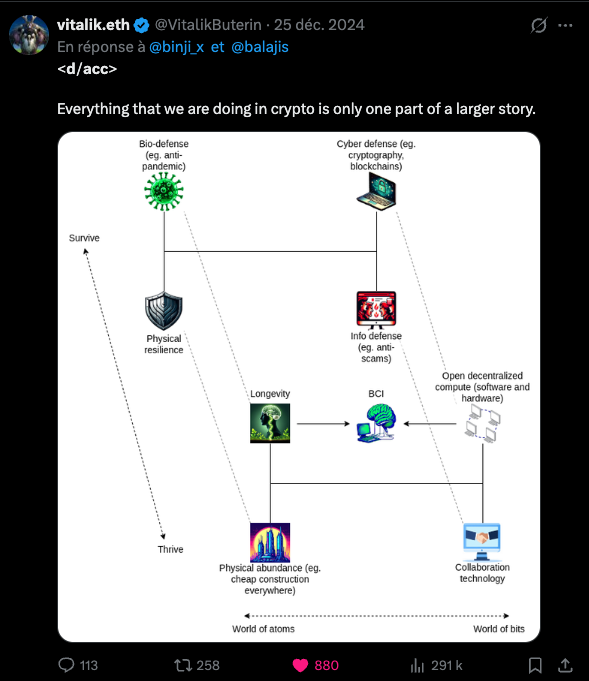
Two things make the pie click. Look at the edges and you'll see two axes:
- Atoms » Bits. Some defensive tech lives in the physical world (air, buildings, your body). Some lives in the digital world (data, code, money). d/acc covers both — which is the first clue it's bigger than software.
- Survive » Thrive. Some of it keeps you alive (don't die in a pandemic). Some of it helps you flourish (live longer, build more, think clearer). Defense isn't only about dodging disaster.
Now let's walk a few slices.
Bio-defense (atoms · survive)
The slice is surprising. d/acc cares enormously about your body's exposure to threats, and the answer isn't a billion-dollar lab, it's cheap, open, distributed tools. Buterin points to open-source vaccine designs and better air filtration as flagship d/acc work, including pocket air testers that can detect airborne viruses and improve over time through software updates. A $50 device that tells you the air in a room is unsafe is defensive acceleration in the most literal sense (no blockchain required).
Physical resilience & abundance (atoms · thrive)
Cheap energy. Cheap construction. Local manufacturing. The ability for a community to make what it needs without asking permission from a far-away supply chain. This is the "thrive" edge of the physical world. Technology that makes ordinary people more self-sufficient instead of more dependent. A small town with its own solar grid is harder to coerce than one plugged into a single utility. That's d/acc thinking applied to atoms.
Info defense (bits · survive)
How do you defend a society from lies, scams, and manipulation without installing a Ministry of Truth? d/acc's answer leans on open, bottom-up tools: the consensus-mapping you saw with Polis in the last section, community-driven context, and prediction markets (places where people bet real money on what's true, which turns out to punish confident liars surprisingly well). The goal: make truth cheaper to find than lies are to spread.
The clearest example already lives in the human-rights world — open-source verification, where distributed networks of volunteers use public evidence (satellite imagery, geolocation, timestamps) to confirm what really happened and debunk official propaganda. Groups like Bellingcat have used exactly these methods to document atrocities that governments tried to bury.

Cyber defense (bits · survive)
This is the crypto slice — encryption — and the deeper magic of proving things without revealing them (the tech that lets you prove you're over 18 without showing your birthday, or prove you have the money without showing your bank balance). It's a genuine rabbit hole, and it gets its own optional Deep Dive A later. For now, just file it as one slice of a much bigger pie or the digital lock that keeps the offense out.
And yes — even the weird stuff (thrive)
Longevity research. Brain-computer interfaces you actually own instead of rent. The far "thrive" edge of the pie gets sci-fi, and that's the point: d/acc isn't only playing defense against the apocalypse. It's also asking how we flourish on our own terms, without handing the keys to whoever builds the tech first.
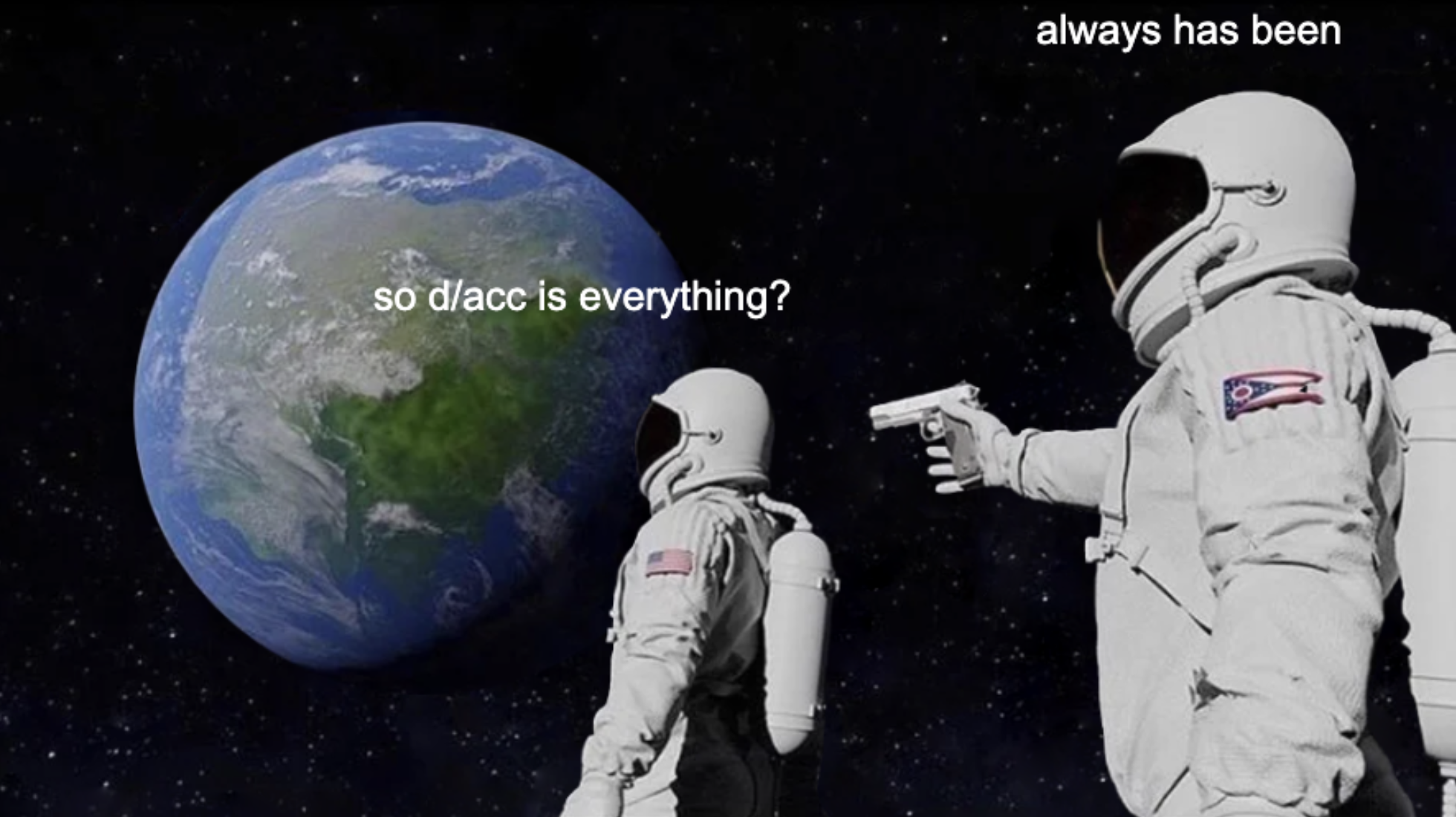
Step back and the whole pie rhymes with one question, the same one from Section 2:
Does this technology hand power to the individual, or take it away?
Air filters, encryption, open vaccines, community-owned grids, lie-detecting markets — wildly different tools, identical instinct. That instinct is d/acc.
If you've ever championed open-source software, defended encryption, fought surveillance, or built tools for people under hostile governments, you've been doing d/acc all along.
You just didn't have the word for it. Now you do.