
Section 2 — What the D's Actually Mean
Section 2 — What the D's Actually Mean
~3 min
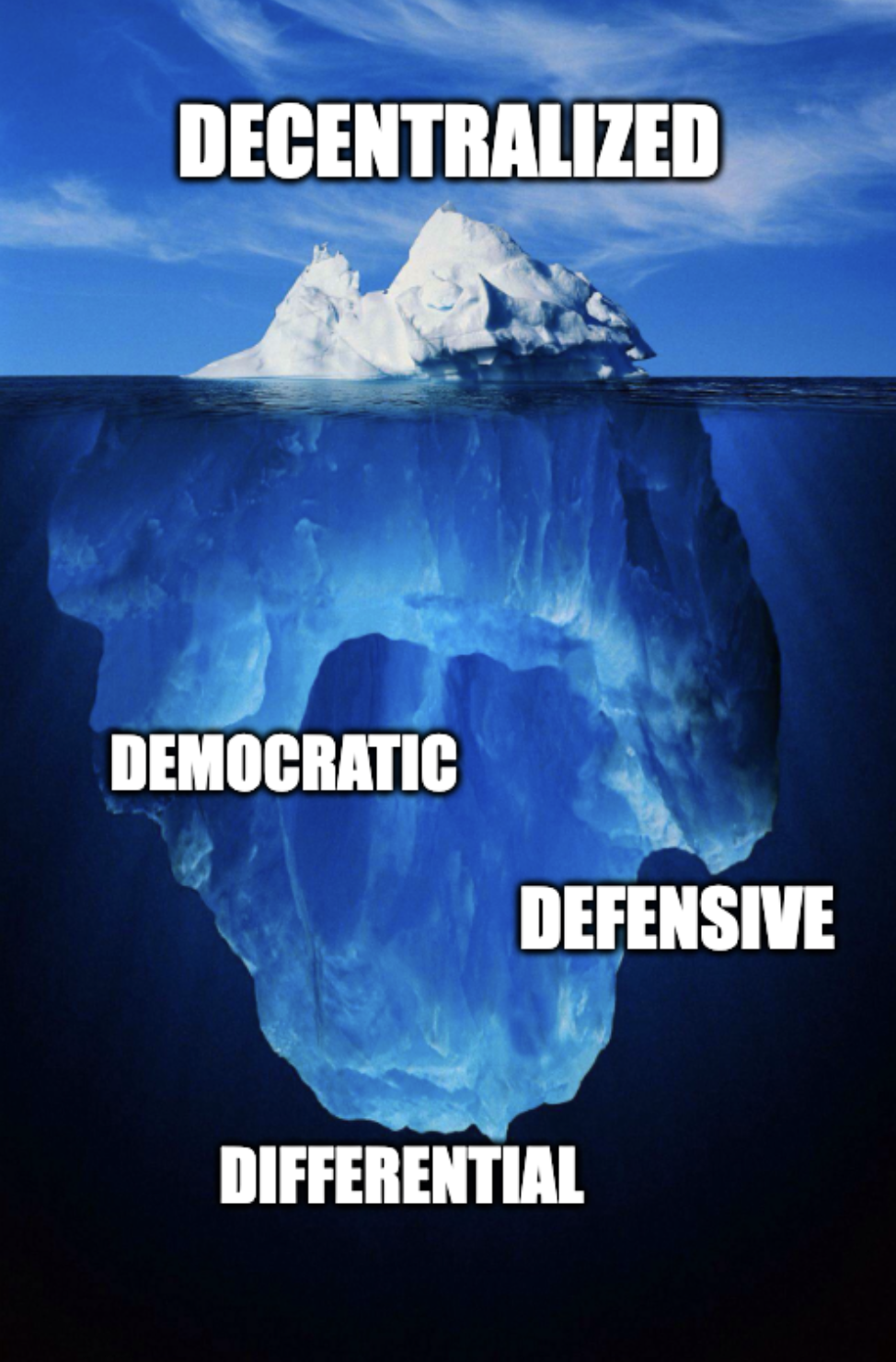
Most people see "d/acc," assume the d stands for decentralized, and move on. They're not wrong, but they're missing three-quarters of the idea. The d is really a stack of four words, and the last one is the secret sauce nobody talks about.
Defense
The heart of the whole thing. d/acc favors technology that protects over technology that attacks.
The tell is asymmetry. A vaccine helps you whether you're rich or poor, powerful or powerless — it's defensive, and it spreads its benefit evenly. A bioweapon only helps whoever built it. Same biology, opposite politics. A lock on your door protects you. A master key held by one company "for your convenience" protects them.
d/acc says: when you have a choice, build the lock, not the master key.
Decentralization
Power shouldn't pile up in one place, because a single point of control is also a single point of failure.
Think about email. No one company owns it. If one provider goes down or kicks you off, you still have email everywhere else. Now think about a single social platform: one policy change, one ban, one outage, and your entire presence vanishes. One of these systems survives a bad actor at the top. The other is the bad actor at the top, waiting to happen.
Decentralization is just refusing to put all of civilization's eggs in one baske, especially when you don't own the basket.
Democracy
Who gets a say in how the technology runs?
Compare an encyclopedia written behind closed doors by one company to Wikipedia, edited in the open by thousands. Or look at Taiwan, which faced a screaming, years-long deadlock over whether to allow Uber. Instead of letting it rot in parliament, the government ran it through a tool called Polis, a discussion platform with one weird rule: no reply button. You can agree with a statement, disagree, or write your own, but you can't dunk on anyone. Strip out the fighting and the software starts mapping where people already agree. The Uber fight turned out to be, underneath the noise, a fight everyone shared about passenger safety. Consensus that had been impossible for six years showed up in a few weeks, and it became actual law.
That's the democratic "d." Not voting every four years, but whether the people a technology affects can actually shape it, or just live with whatever they're handed.
Differential — the secret one
Here's the move almost everyone misses, and it's the whole game.
d/acc does not say "accelerate everything." It says: accelerate the defensive, decentralizing, democratic technologies faster than the offensive, centralizing ones, so the good stuff stays ahead in the race.
It's a differential: a gap you're deliberately trying to maintain. Think of medicine racing to stay ahead of disease, or armor keeping pace with new weapons. The danger isn't technology moving fast. The danger is offense moving faster than defense: surveillance outrunning encryption, bioweapons outrunning vaccines, manipulation outrunning the tools to detect it.
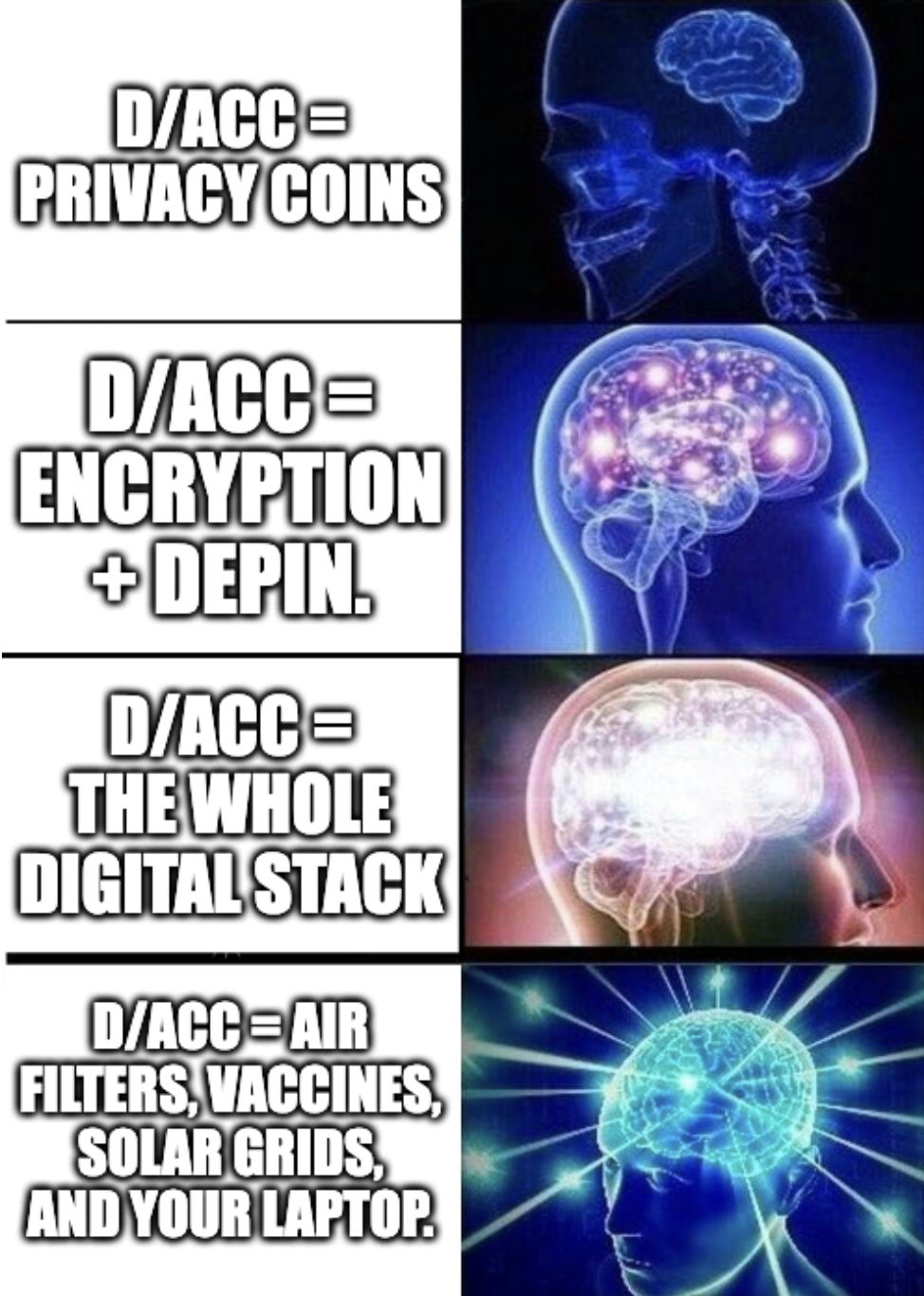
This is what separates d/acc from plain old techno-optimism. Optimists say "tech good, more tech." d/acc says "tech is a race between offense and defense, and we'd better make sure defense wins." That single word — differential — is why d/acc has a steering wheel and not just a gas pedal.
Put the four together and you get the full name Vitalik actually uses: decentralized and democratic, differential defensive acceleration. A complex one. But now you know every word has a story behind.