
Section 4 — Audit Your World
Section 4 — Audit Your World
~4 min
Everything so far has been theory. Here's where it becomes a tool you'll actually use.
Pick up your phone. Most of the apps on it are quietly offense-leaning, built to harvest you, lock you in, and run on infrastructure you'll never control. d/acc gives you a way to see that, score it, and start switching. We call it the d/acc scoring.
It rates any tool — an app, a device, a protocol — across five questions. Each gets a score:
0 — Fails. Centralized, data-hungry, or a closed black box. 1 — Mixed. Some defenses, but with strings attached. 2 — True d/acc. Defensive by default, and it hands you the control.
Ten points total. Here are the five questions.
1. Sovereignty — Who owns the data? 0: It all runs on Big Tech's servers — one company can pull the plug. 1: Spread across many servers, but still leans on a few trusted middlemen. 2: Runs peer-to-peer or on your own device. You hold the keys.
2. Encryption — Can anyone read your stuff but you? 0: No real encryption — the company can read it. 1: Encrypted, but not by default, or it still logs who you talk to and when. 2: End-to-end encrypted out of the box, and it barely collects metadata.
3. Transparency — Can outsiders inspect the code? 0: Closed source. "Trust us." 1: Partly open, but with catches. 2: Fully open source — anyone can check the lock actually works.
4. Agency — Does it serve you, or farm you? 0: Manipulative feed, your data's trapped, leaving is a chore. 1: You can export your data, but it nudges and harvests you. 2: It defends your time and attention, and you can walk out with everything.
5. Resilience — Can it survive a shutdown order? 0: One court order or boardroom decision kills it. 1: Tougher to block, but still has a central off-switch. 2: No off-switch — it can't be cleanly shut down.
Worked example: Signal vs WhatsApp
Both let you message people. Both even use the exact same encryption for your message content — Signal's. So they're basically equivalent, right?
Run the audit and watch them split apart.
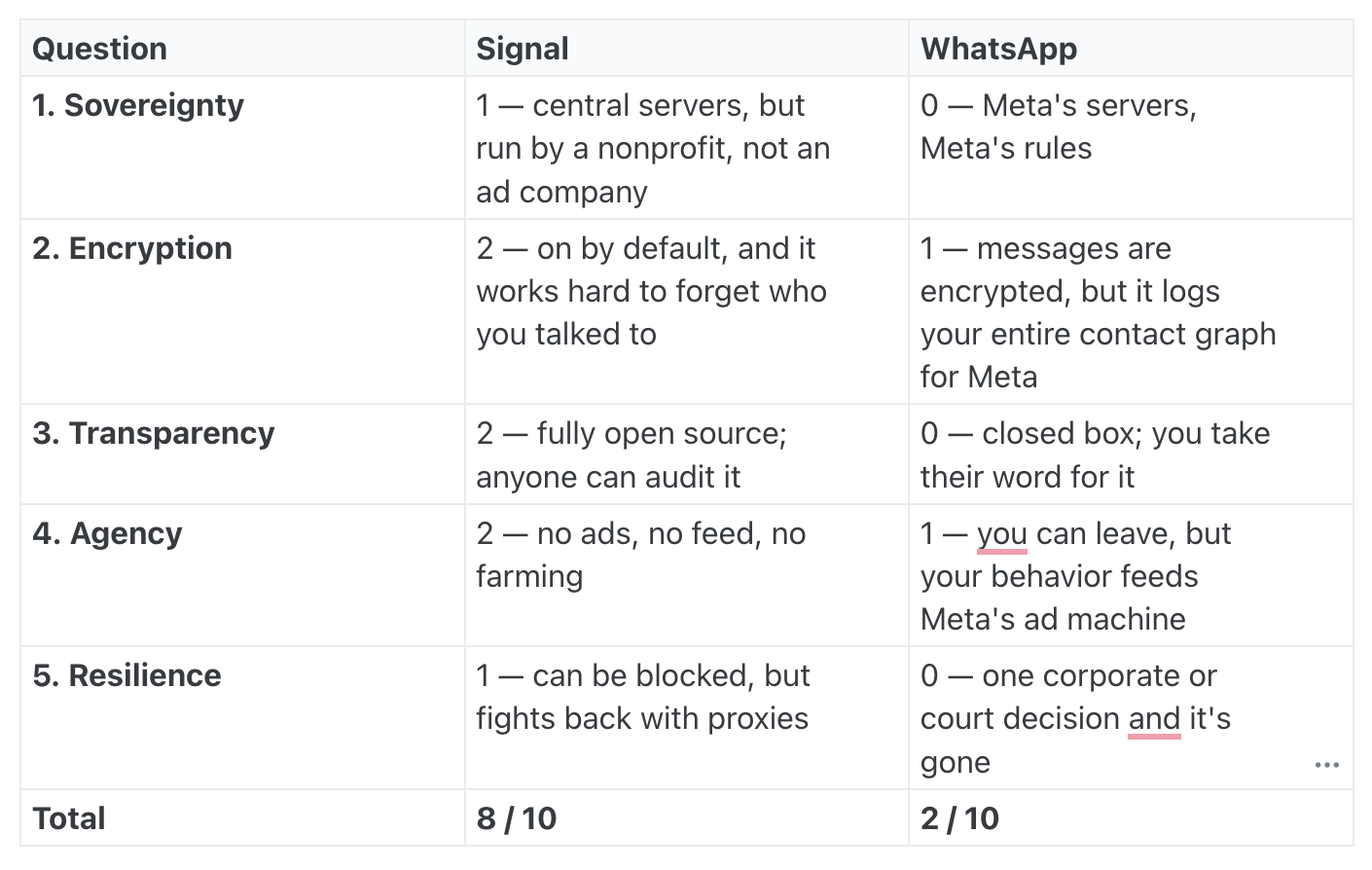
The lesson isn't "Signal good, WhatsApp evil." It's subtler and more useful: the lock on the message is identical — the difference is everything around it. Who owns the servers. Who can read the code. Who profits from your contact list. That's where offense hides, and that's what the audit drags into the light.
Notice Signal doesn't score a perfect 10 either. It loses points for running on central servers — proof the audit is a real measurement, not a fan club. Even the good guys have homework.
Now do it yourself
Pick one app you open every day. Browser, maps, notes, whatever. Score it, honestly, across the five questions.
You'll feel one of two things: "huh, better than I thought" or a small, useful discomfort. That discomfort is the entire point of this course. It's the moment you stop being a product and start being a participant.
Then switch one thing. Just one. That's d/acc is not as a philosophy you read, but as a choice you made today.